


Resident Care Plans: Goals, Meetings, Reviews and Examples
In this article
Every shift needs instructions staff can carry out and document. A goal such as “improve mobility” gives no shared measure of progress.
This guide is primarily for care managers, directors of nursing, and clinical leads. US deadlines apply to Medicare- or Medicaid-certified nursing facilities; assisted-living requirements vary by state.
Use the goal formula, worked example, meeting checklist, review triggers, and escalation route to build person-centred plans and check agreed support between formal reviews.
What is a resident care plan?
A resident care plan is a formal written record agreed with the resident and interdisciplinary team. It connects assessed medical, functional, psychosocial, communication, and personal needs with goals and daily support.
The plan turns assessment findings and resident priorities into instructions caregivers can follow, record, and review.
Care-plan flow: Resident assessment and priorities → agreed goals and interventions → shift instructions → daily records → formal review and revision
Clinical information: records diagnoses, treatment schedules, and medication instructions.
Daily living support: states the help required with bathing, dressing, eating, and mobility.
Personal preferences: captures dietary needs, social preferences, and familiar routines.
Measurable goals: sets a baseline and tracks progress in physical function, mental health, and social wellbeing.
Team responsibility: names who owns each intervention, record, escalation, and review decision.
Shift-to-shift use: gives frontline staff clear routines, precautions, assistance levels, and progress measures.
Nursing home vs. assisted living care plans: what's different
Medicare- or Medicaid-certified nursing facilities follow federal care-planning requirements. Assisted-living plans follow state rules and may be called service plans.
Setting | Focus | Clinical intensity | Oversight | Review cadence | Execution pressure |
|---|---|---|---|---|---|
Nursing home | Medical needs and daily function | Skilled nursing and rehabilitation | Federal standards plus state oversight | Federal assessment and care-planning schedule | Treatments, monitoring, and clinical documentation |
Assisted living | Daily support, routines, and preferences | Varies by resident and state rules | State licensing requirements | State-dependent and triggered by changing needs | Scheduled personal care and service documentation |
Practical check: Base placement discussions on the resident’s assessed needs, preferences, local eligibility rules, and the support available across every shift.
For assisted living, check the state licensing authority and the facility’s written service-plan policy before relying on a review schedule or documentation rule.
The care plan lifecycle, step by step
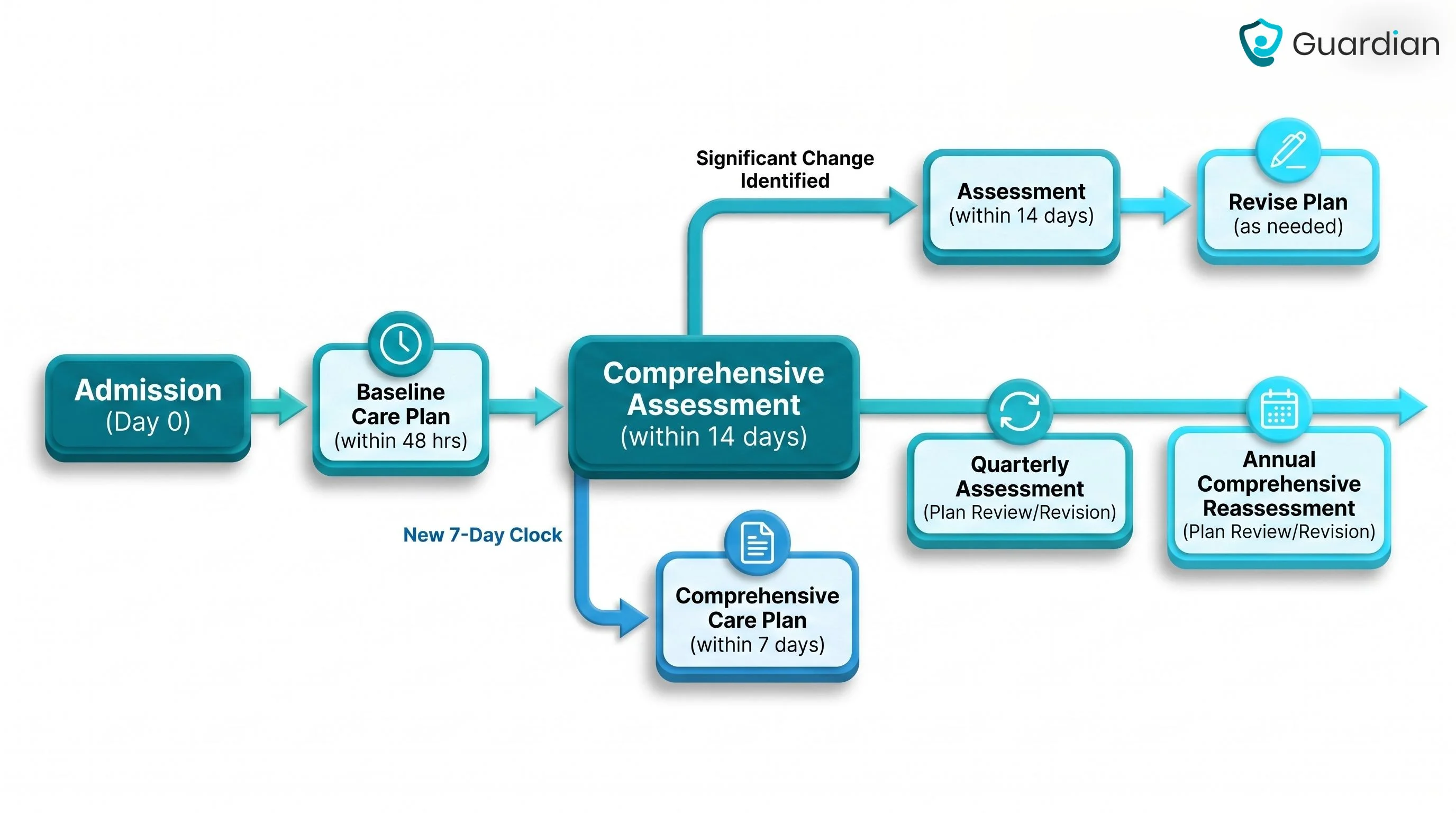
In certified nursing facilities, the lifecycle starts with a 48-hour baseline plan. The comprehensive plan is due within 7 days after the assessment, which is generally completed within 14 days of admission.
Create the baseline plan and summary. Develop and implement the plan within 48 hours of admission. Give the resident or representative its written summary (42 C.F.R. § 483.21(a)).
Complete the comprehensive assessment. Finish it within 14 calendar days after admission, using the RAI to record needs, strengths, goals, life history, preferences, and function (42 C.F.R. § 483.20(b)).
Complete the comprehensive care plan. The interdisciplinary team has 7 days after the assessment to develop and implement the person-centred plan (42 C.F.R. § 483.21(b)).
Run the quarterly review. Complete the required assessment at least once every 3 months. Review and revise the plan after each assessment (42 C.F.R. §§ 483.20(c), 483.21(b)(2)(iii)).
Complete the annual reassessment. Perform a comprehensive reassessment at least once every 12 months, then review and revise the plan (42 C.F.R. §§ 483.20(b)(2)(iii), 483.21(b)(2)(iii)).
Act after a significant change. Once the facility determines, or should have determined, that regulatory criteria are met, complete the assessment within 14 days and revise the plan as needed (42 C.F.R. § 483.20(b)(2)(ii)).
Certified nursing-facility timeline: Admission → baseline plan within 48 hours → assessment generally within 14 days → comprehensive plan within 7 days after assessment → quarterly reviews → annual reassessment, plus qualifying significant-change assessments
What a complete care plan looks like
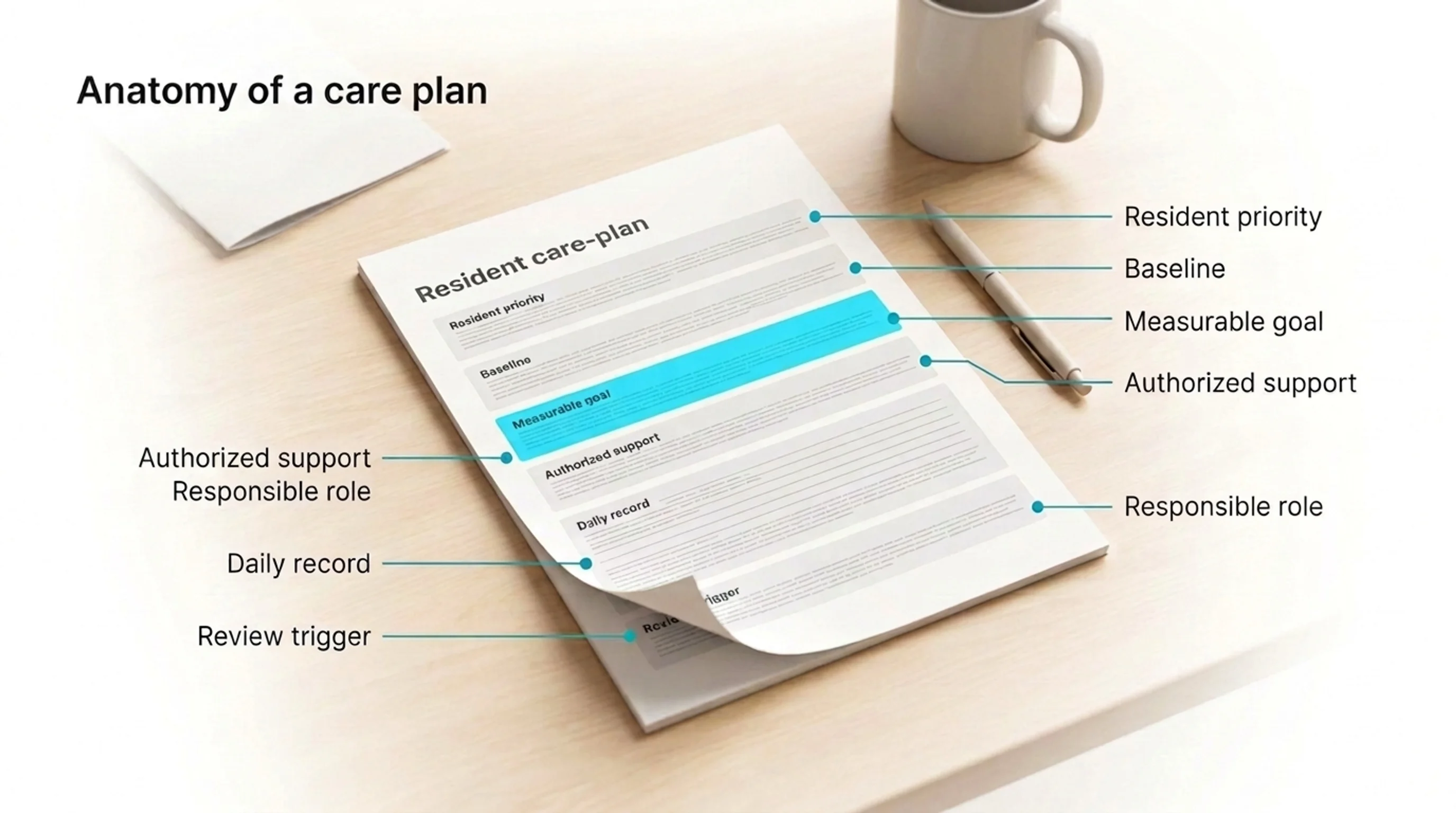
A complete plan identifies the resident’s needs, priorities, baseline, measurable objectives, authorized interventions, responsible roles, timing, records, and review triggers.
In certified nursing facilities, the MDS and CMS RAI Manual inform the assessment record. The care plan then converts those findings into person-centred services and instructions rather than repeating assessment codes.
At handover, staff should know the action, authorized assistance, owner, frequency or condition, evidence to record, and point for escalation or review.
The goal formula: function, measurement, assist level, timeframe
Each goal should connect a resident priority and baseline with a target outcome, authorized support, measure, and review date or trigger. Measures will differ across mobility, medicines, nutrition, skin care, and psychosocial support.
Use these fields to build each goal:
Resident priority: State what the resident wants to maintain, regain, avoid, or do differently.
Baseline: Record the resident’s current function, assistance level, or relevant clinical measure.
Target outcome and measure: Name the expected function and the observable result, such as distance walked or intake against an authorized target.
Authorized support: State the intervention or assistance staff must provide, such as one-carer assistance under the approved mobility protocol.
Review point: Set a date and any earlier trigger, including pain, decline, refusal, an incident, or a change in preference.
Worked formula: From a 10-metre baseline, the resident aims to walk 20 metres to the dining room with the authorized aid and one-carer assistance within 14 days. Review earlier after pain or reduced mobility.
A worked example: one resident's care plan
The following fictional example shows how assessment findings become clear instructions for Resident A.
Illustrative example only. Resident A is fictional, and the details show documentation structure rather than clinical instructions. Each intervention must follow the resident's assessment and authorized care plan.
Mobility: A Morse Fall Scale score of 75 indicates high fall risk. Follow the authorized mobility protocol, record assistance and distance, and review any fall, pain, or reduced function.
Medication management: The RN follows the current MAR, records each administration, and refers pain or blood pressure concerns to the GP.
Skin safety: A Braden Scale score of 17 indicates mild pressure-injury risk. Staff complete authorized repositioning and skin checks, record them, and report new redness or soreness to the RN.
Diet: Serve the dietitian-approved texture and fluids, compare intake with the authorized target, and refer swallowing difficulty or reduced intake to the RN.
Ownership: The RN owns the plan and care staff complete daily entries; the physiotherapist owns the mobility protocol and the GP oversees medicines and blood pressure.
Resident input: Resident A and the family power of attorney confirm preferences, routines, and agreed goals.
Review timing: Review after 90 days or earlier after a fall, pain, skin change, reduced intake, altered mobility, or another change in assessed needs.
Vague goals vs. measurable goals
Staff can audit a goal when the expected result and review point are clear.
Vague goal | Measurable rewrite |
|---|---|
Improve mobility | Transfer with one-person assistance within 30 days |
Prevent falls | Zero injury falls during the 90-day review period |
Manage medicines better | Record every scheduled dose on the MAR |
Protect the resident's skin | No new pressure injury at the 90-day review |
Improve diet and hydration | Meet recorded intake targets by the 90-day review |
Daily notes should record the target result and assistance provided, so the RN can spot drift before the formal review.
Who's involved in building the plan
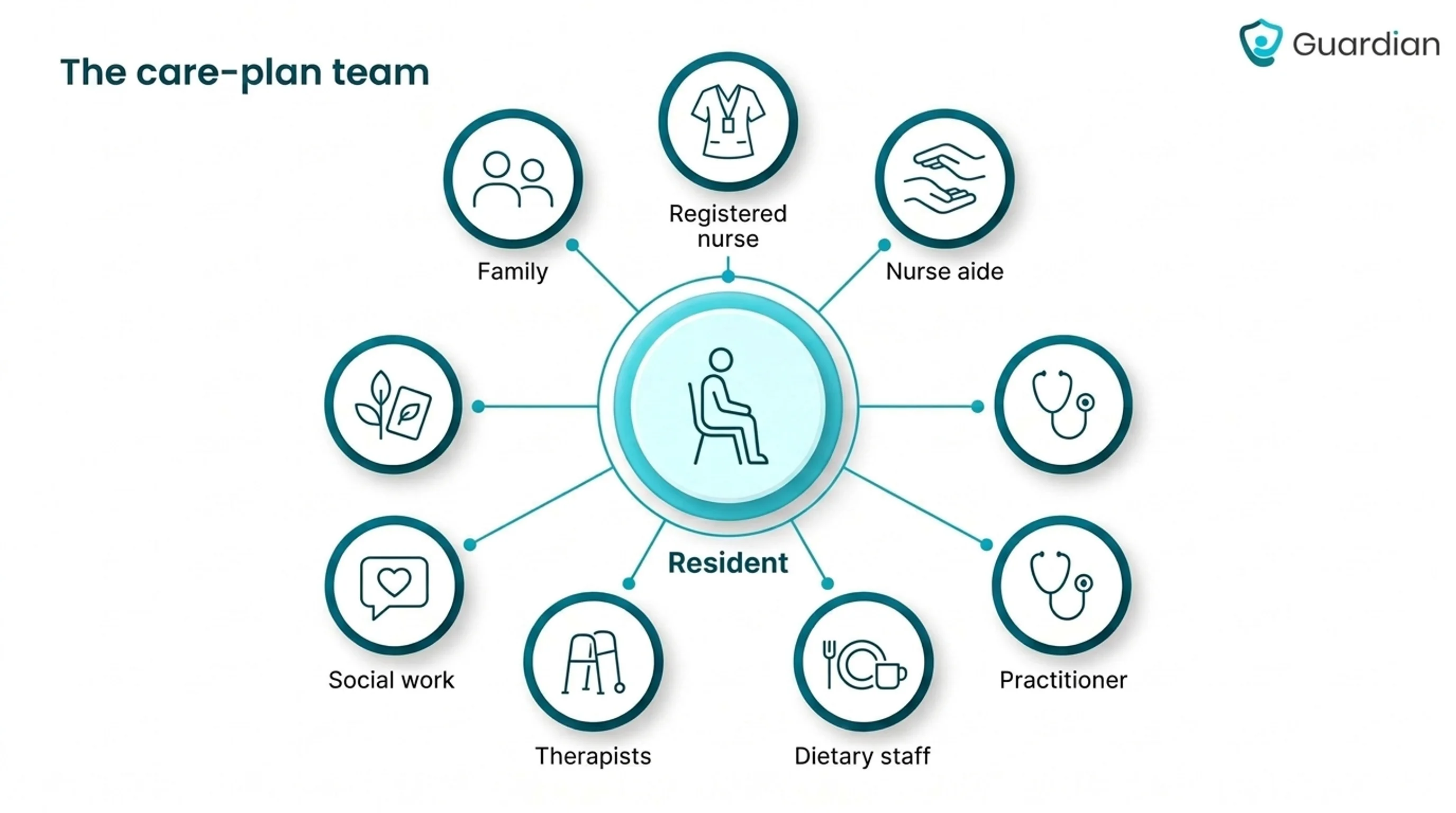
The resident’s priorities guide the care plan, while an interdisciplinary team records the support, clinical instructions, and follow-up needed to carry them out.
Resident: sets priorities and describes preferred routines, including the support they find acceptable day to day.
Representative or family: adds history and preferences when the resident wants support or cannot participate fully, while keeping the resident’s wishes central.
Registered nurse and, where applicable, MDS coordinator: coordinate assessments, turn findings into goals and interventions, define monitoring and review criteria, and communicate the authorized plan. MDS coordination applies to relevant US nursing-facility workflows.
Attending physician or other authorized practitioner: contributes orders, diagnoses, treatment decisions, and clinical follow-up within their scope.
Nurse aide: contributes direct observations about mobility, personal care, sleep, appetite, behaviour, and changes seen during daily support.
Dietary staff: records nutrition needs, allergies, food preferences, swallowing precautions, hydration support, and how intake will be monitored.
Therapists: physical, occupational, and speech-language therapists add goals for movement, daily tasks, communication, or swallowing when those needs apply.
Social work: covers psychosocial needs, resident rights, family concerns, service coordination, and discharge or transfer planning.
Activities staff: connects the plan to the resident’s interests, cognitive abilities, social preferences, and meaningful daily participation.
Each contributor records observations, named actions, and escalation steps in the care plan. Staff can then see what changed, who needs to respond, and when clinical review is required.
Care-plan team: Resident at the centre → representative or family support → responsible RN and nurse aide → attending practitioner → dietary, therapy, social work, activities, and other relevant professionals
Getting ready for a care plan meeting
For care managers and clinical leads, preparation starts with changes since the last review and the resident’s current priorities. In a US nursing facility, confirm which MDS assessment information will inform the meeting.
☐ Confirm the timing: Check the date, start time, expected length, and deadline for submitting information.
☐ Confirm attendance: Ask which manager, nurse, care staff member, therapist, clinician, and resident representative will attend.
☐ Arrange participation: Confirm consent, the resident’s preferred communication method, decision-making support, remote access, and any interpreter or accessibility needs.
☐ Record changes: Note changes in mobility, transfers, cognition, pain, falls, sleep, eating, continence, or personal care.
☐ Gather current records: Bring relevant assessments, therapy updates, incident reviews, weight or intake records, medication changes, and resident feedback.
☐ Capture routines: Write down what helps with meals, medication, bedtime, distress, social activity, and other daily patterns.
☐ Set priorities: Ask the resident what they want to maintain, regain, avoid, or do differently, then bring the clearest examples to the meeting.
Use dates and observable examples where possible, such as needing help to stand after previously transferring independently.
Questions to ask during the meeting
Use the meeting to establish who will do each task, how staff will record it, and how progress will be judged. Ask for plain answers that can be written into the care plan.
Resident priorities: Which goals and routines matter most to the resident, and how will the plan reflect their choices and consent?
Shift ownership: Which role is responsible for each activity on each shift, including washing, dressing, toileting, meals, repositioning, and mobility support?
Assistance records: Where will staff record the help given, refusals, missed care, and changes from the planned assistance level?
Therapy milestones: What is the next measurable therapy milestone, who will review it, and when will the team decide whether to progress or maintain the goal?
Transfer support: What assistance level and equipment does the assessment authorize, and what evidence would support any safe change?
Medication changes: Which medicines or doses changed, and what effects or concerns should staff monitor and escalate?
Choice and refusal: How should staff respond, document, and escalate when the resident refuses support or changes a preference?
Earlier review: Which incidents, symptoms, functional changes, or missed milestones should bring the next review forward?
Post-fall review: After a fall, who checks for injury and medication factors, updates environmental safeguards, and tells the resident representative what changed?
Before the meeting ends, repeat back the agreed actions, named owners, and review points so the written plan has a clear reference.
What to check after the meeting
After the meeting, check that the final care plan matches the decisions made and that frontline staff have usable instructions. Follow the updated plan through records and direct observation.
Obtain the final plan: Confirm when changes take effect and how the resident or authorized representative can access the updated plan under the facility’s records policy.
Compare agreements: Check each agreed assistance level, therapy schedule, dietary change, medication instruction, and safety measure against the final plan.
Verify communication: Confirm that named owners received the update and that handovers, care logs, and staff instructions reflect it. Check that the resident understands the agreed changes.
Watch execution: During visits or shift reviews, note whether care matches the plan and record specific gaps with dates, tasks, and follow-up responses.
Escalate persistent gaps: Ask the responsible manager to correct missed execution and set a review date. Revise the plan only when assessment, goals, preferences, or authorized support have changed.
When a care plan should change
Review the care plan when the resident’s assessed needs, goals, or preferences change, and during the facility’s scheduled review cycle. A single event may prompt assessment, but it does not automatically require an immediate reassessment.
Clinical event, assess promptly: Take immediate safety or clinical action after a fall, sudden confusion, unexpected weight loss, new skin damage, or treatment concern. Revise the plan when assessment identifies changed needs or interventions.
Return from hospital: Reconcile orders, medicines, restrictions, follow-up, and the resident’s current baseline with the authorized clinician before relying on the previous plan.
Medicine or treatment change: Assess side effects, new monitoring requirements, and changes in response. Update the plan when they alter the resident’s support or clinical instructions.
Routine review, scheduled: Compare current needs and progress with the existing goals, interventions, and staff assistance levels during the facility’s required review cycle.
Functional milestone, prompt update: Revise goals and assistance levels when the resident gains mobility, misses a therapy target, or loses a skill the plan assumed they had.
Preferences or discharge direction, prompt update: Record changes to daily routines or dietary choices, and revise goals when the resident begins preparing to return home or move elsewhere.
Resident rights, and what to do if the plan isn't followed
In US Medicare- or Medicaid-certified nursing facilities, residents have rights to participate in care planning, access their records, refuse treatment, and use grievance procedures without retaliation. Other settings follow their local rules.
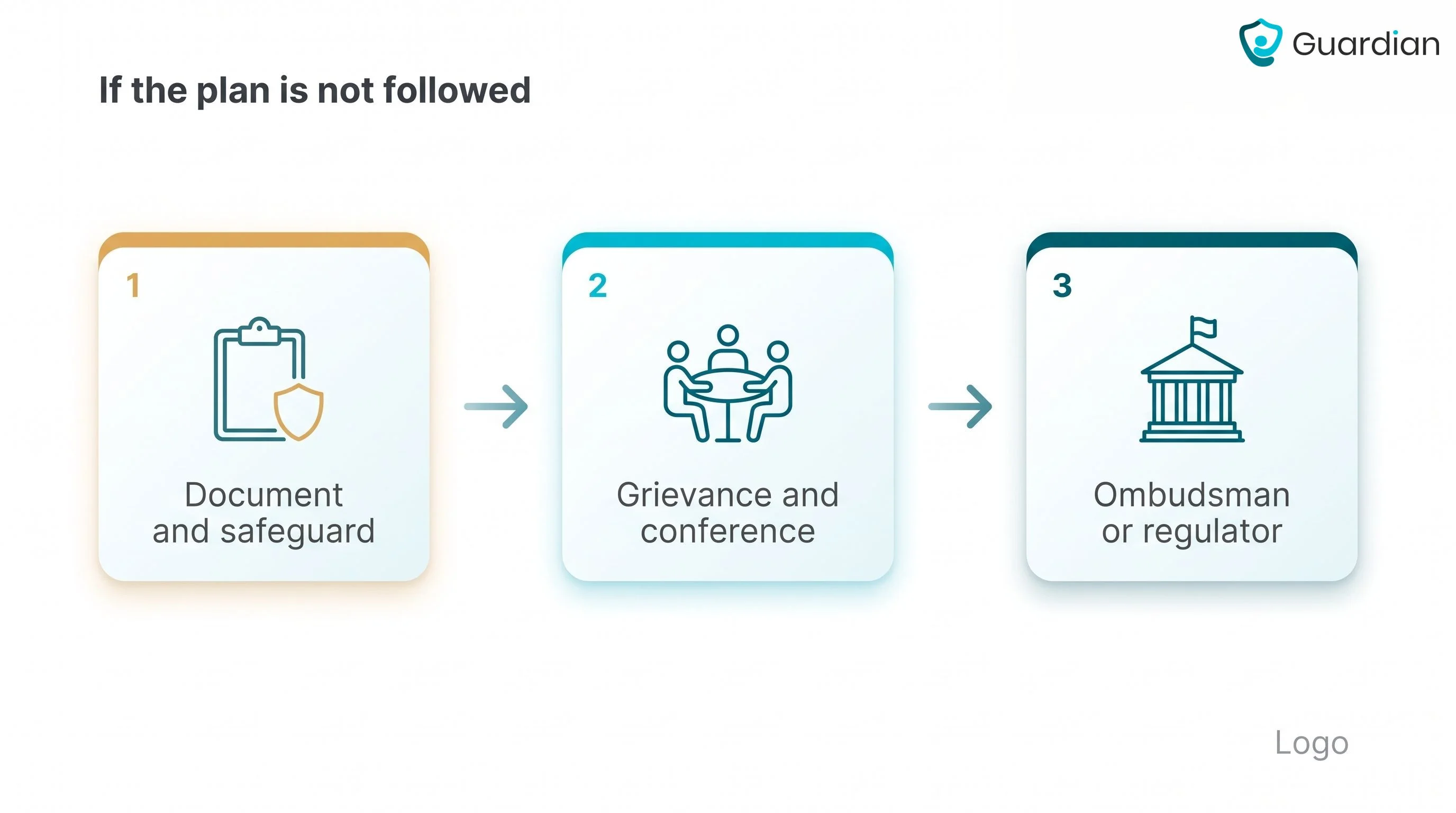
Stage 1: Confirm the resident's rights
Under 42 CFR § 483.10, the resident may participate, request revisions, see the plan, refuse treatment, and raise grievances. A representative exercises only the authority delegated by the resident, a court, or state law.
Ask the facility for its written resident-rights policy. Rules and regulator names differ by country, state, and care setting.
If there is immediate danger, suspected abuse or neglect, or a medical emergency, use emergency services and the required safeguarding or reporting route rather than waiting for the normal grievance sequence.
Stage 2: Escalate inside the facility
Document the missed care and the date. Note its effect on the resident and who you told.
Follow the grievance procedure. Keep copies of the policy, your complaint, and each reply.
Request an interim care conference in writing. Ask leaders to review the missed care, agree safeguards, assign responsibilities, and correct execution. Update the plan only when needs, goals, preferences, or authorized support changed.
Stage 3: Escalate outside the facility
Contact the Long-Term Care Ombudsman. In the US, the ombudsman can explain options and help raise unresolved concerns with the facility. Elsewhere, contact the equivalent independent care advocate.
File with the relevant regulator when safety concerns remain. In the US, contact the state survey or licensing agency; elsewhere, use the national or regional health and social care regulator.
Escalation route: Document and address immediate safety → use the facility grievance and care-conference process → contact the ombudsman, licensing agency, or equivalent external body if concerns remain
Backward-looking logs make daily care-plan commitments difficult to verify because the record is assembled after the care should have happened.
Between meetings, how do you know the plan is being followed?
You can verify care plan execution between formal reviews by comparing daily observations with authorized care records and asking frontline staff about handovers. Regular checks can catch gaps before the next scheduled review.
For an internal quality check, choose a regular interval and compare authorized records, direct observations, staff handovers, and resident feedback with scheduled support and measurable goals.
Personal care: Authorized staff review bathing and oral-care records, ask the resident about support, and address missed or refused care without unnecessary physical inspection.
Pressure-area care: Authorized staff check repositioning and skin records, complete observations with consent and privacy, and escalate new redness, soreness, or skin changes.
Medication and daily flow: Review the Medication Administration Record (MAR) and daily flow sheets. Ask about any blank or unexplained entry.
Measurable goals: Compare progress with the assistance level, measure, and timeframe in the authorized plan, such as walking to the dining room with one-person support when that goal is documented.
Shift handovers: Ask the same focused question on each shift to confirm a specific instruction transfers consistently between staff.
Soft signs: Keep a dated note of changes, such as lower appetite or unusual confusion. Record who you informed and the response.
Access to care records depends on the resident's authorization, your representative status, and the facility's procedure. Ask the facility which records it can share and how to request them.
Pair the written record with direct observation and a short conversation with frontline staff. A missing entry, changed routine, or inconsistent handover gives you a specific point to clarify.
Guardian can add automatic operational records to those checks without replacing the authorized care plan or clinical record.
Guardian Insight: Checking care-plan follow-through
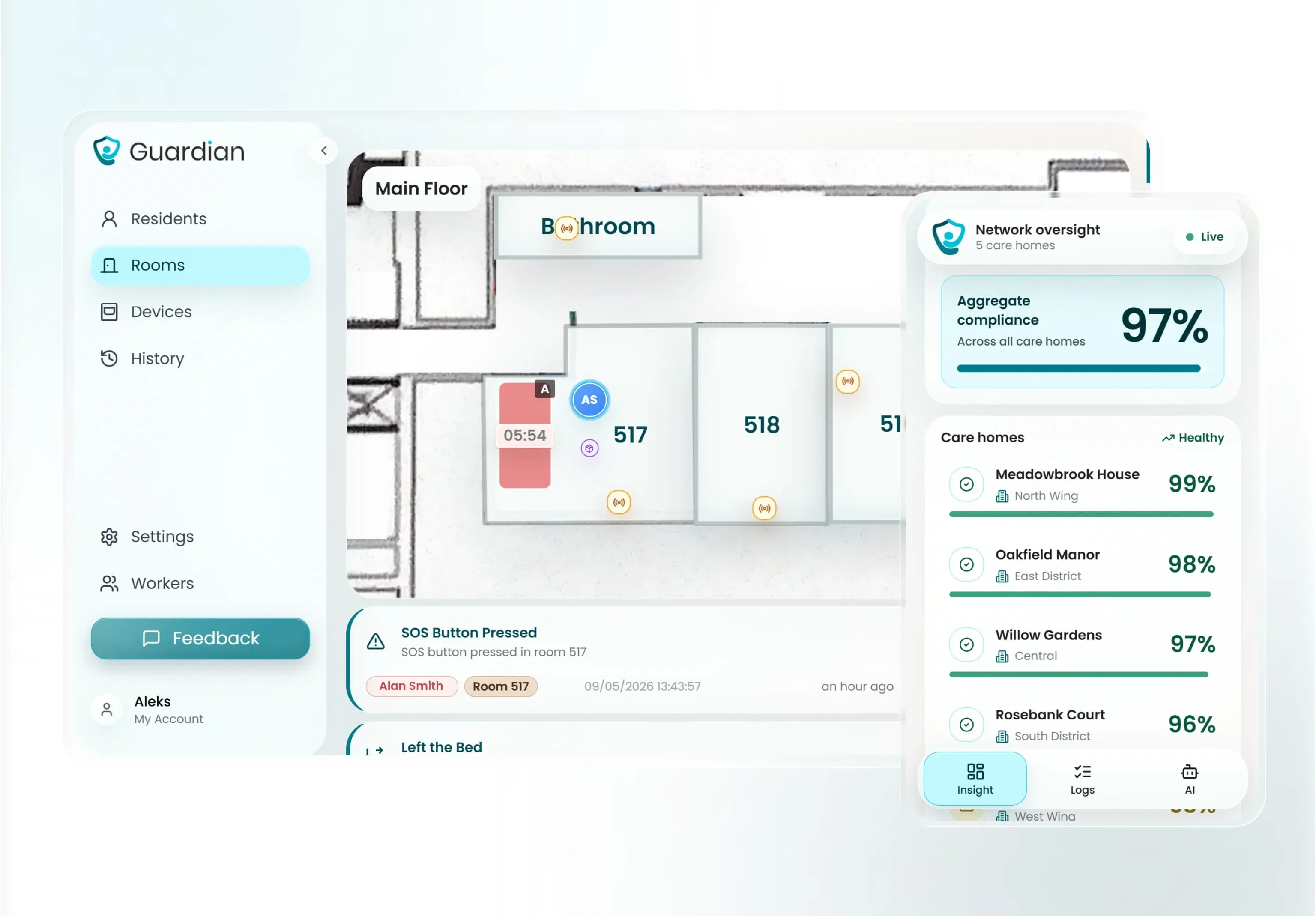
Guardian is a wireless, camera-free operations and safety monitoring platform for care homes, home care providers, and other care settings. Guardian Insight is its dashboard for residents, staff, alerts, vehicles, assets, and records.

Guardian records operational events such as visits, bed exits, exits, and unusual inactivity. It applies manager-set rules, sends location-aware alerts to existing devices, and records alert and response timing.
Managers can compare timestamps, visit records, routine changes, and response times with selected care-plan commitments. Automatic records help identify missed visits, delayed responses, and patterns that need staff review.
Guardian does not prove that medicine was administered correctly, personal care was completed, intake met a target, or a clinical intervention followed the plan. Those checks still require authorized care and clinical records.
Alerts go to phones, tablets, or nurse-station computers staff already use. Guardian runs in the background, while Guardian Insight gives managers one live operational view.
A 6–8 week pilot can cover one ward, care setting, or home care team. The impact report uses that operator’s response times, visit records, and workflow data to support a rollout decision.
For Medicare- and Medicaid-certified nursing facilities, the interdisciplinary team reviews and revises the plan after each required assessment, including quarterly reviews, annual comprehensive assessments, and qualifying status changes under the assessment rules.
A major physical or mental change can trigger an off-schedule assessment. Once the facility determines, or should have determined, that the regulatory criteria are met, it has 14 days to complete the assessment under the care-plan rules.
Yes, when the resident authorizes access or a representative holds the necessary authority under state law or a court order. Family relationship alone does not provide access to the resident’s records.
Federal records rights require certified nursing facilities to give the resident, or a representative exercising that right, access within 24 hours, excluding weekends and holidays. Copies require two working days’ advance notice; permitted fees may apply.
A care plan meeting usually refers to the interdisciplinary process required by the federal care-plan rules, with resident or representative participation when practicable.
“Care conference” may describe that meeting or a broader discussion after a hospital discharge, fall, or change in palliative goals. The required process still needs an assessment-based plan and the appropriate participants.
Ask the administrator or director of nursing for the plan in writing. A certified nursing facility must prepare a baseline plan within 48 hours and complete the comprehensive plan within seven days after the comprehensive assessment, which is generally due within 14 days of admission under the care-plan rules.
After a missed deadline, file a written grievance under the federal grievance rules and keep a copy. The Ombudsman Program gives free independent help; assisted-living deadlines depend on state law.
Start with the state licensing authority and the facility’s written service-plan policy. States use different names, required participants, review deadlines, and documentation rules, so federal nursing-facility timing should not be applied automatically.
Record the resident’s concerns and support them to understand the options, risks, and alternatives. In a certified nursing facility, the resident may participate, request revisions, and refuse treatment under the resident-rights rules.
The team should update the plan when the resident’s informed choice changes the agreed services or goals. Immediate safety concerns still require appropriate clinical or safeguarding action.

Author
Aleks Timm
Aleks Timm leads Guardian and builds privacy-first operations technology for care homes and home care providers. Teams get location-aware alerts they can act on, clearer situational awareness, and measured insight into how care work actually runs.
Read MoreRecommended reads
Keep reading
Remote patient monitoring: a complete guide
Remote patient monitoring: the complete guide to sensors, benefits, and buying tips for safer care homes and better resident...
Read more
Smart Nurse Call Systems for Care Homes and Home Care Providers
Smart nurse call systems for care homes and home care providers: compare features, improve response times, and choose the right...
Read more
WiFi nurse call system guide for care homes
WiFi nurse call systems explained: alerts, clean records, and no wiring—compare options and choose the right setup for your care...
Read more