


How to Help Elderly Parents From a Distance: A 15-Step Care Plan
In this article
Phone calls capture a few minutes, not the day around them. A parent may sound well while meals are missed, sleep changes go unnoticed, or a scheduled visit ends early.
Long-distance care works best with a nearby response network, one shared record, and an agreed escalation plan. This 15-step guide starts with consent and adds monitoring only where local checks leave gaps.
Start with these five actions
Check for immediate danger.
Speak with your parent and agree on one first step.
Name a local contact and backup.
Create one current care record.
Write the missed-contact and emergency response plan.
What long-distance caregiving involves
Long-distance caregiving is a care arrangement for an older parent when distance limits daily in-person help.
The arrangement puts local people in charge of in-person support while you coordinate decisions and information from afar. It needs four parts:
Communication with your parent and local helpers
Scheduling for appointments, home support, and follow-up
A shared record of visits, changes, and agreed actions
Targeted monitoring for gaps between visits
The remote coordinator keeps the plan, appointments, and updates current. Local responders observe conditions, provide hands-on help, and act when a call, visit, or alert raises concern.
Phase 1: Assess and agree
1. Assess immediate needs and agree on help

Repeated changes in routine need a structured review, not another casual check-in. Act sooner when missed meals, medication confusion, falls, or wandering suggest that current support is no longer enough.
Start a structured assessment when you notice:
Daily routines: Missed appointments, missed meals, poor hygiene, or unopened mail.
Medication: Confusion about what was taken or when.
Home safety: Repeated fridge or stove problems.
Mobility: A fall, new unsteadiness, or difficulty managing usual tasks.
Orientation: Wandering, getting lost, or unusual confusion.
Outside concern: A neighbour or local caregiver says the current arrangement is unsafe.
Handle urgent risks before making the wider plan
Treat a fall with injury or serious medication problem as urgent. For wandering or lack of food, ask a trusted nearby person to check and call emergency services if danger is immediate.
Once the immediate risk is contained, identify what your parent still manages independently and where help is now needed.
Agree on the smallest workable step
Ask which routines your parent wants to keep managing and which task would be easiest to share.
Bring specific observations, such as missed meals or unopened mail, then ask whether your parent has noticed the change.
Suggest the smallest support that covers the risk, such as one local check-in or help with one routine.
Write down the help your parent accepts. Record who may be involved and set a review date.
Your parent decides which help to accept while they can understand and weigh the decision. Record who will check in, what they will do, and when you will review the plan.
If confusion may affect that decision, seek a qualified capacity assessment and follow local law. Arrange urgent in-person help when there is immediate danger.
2. Build a local care team
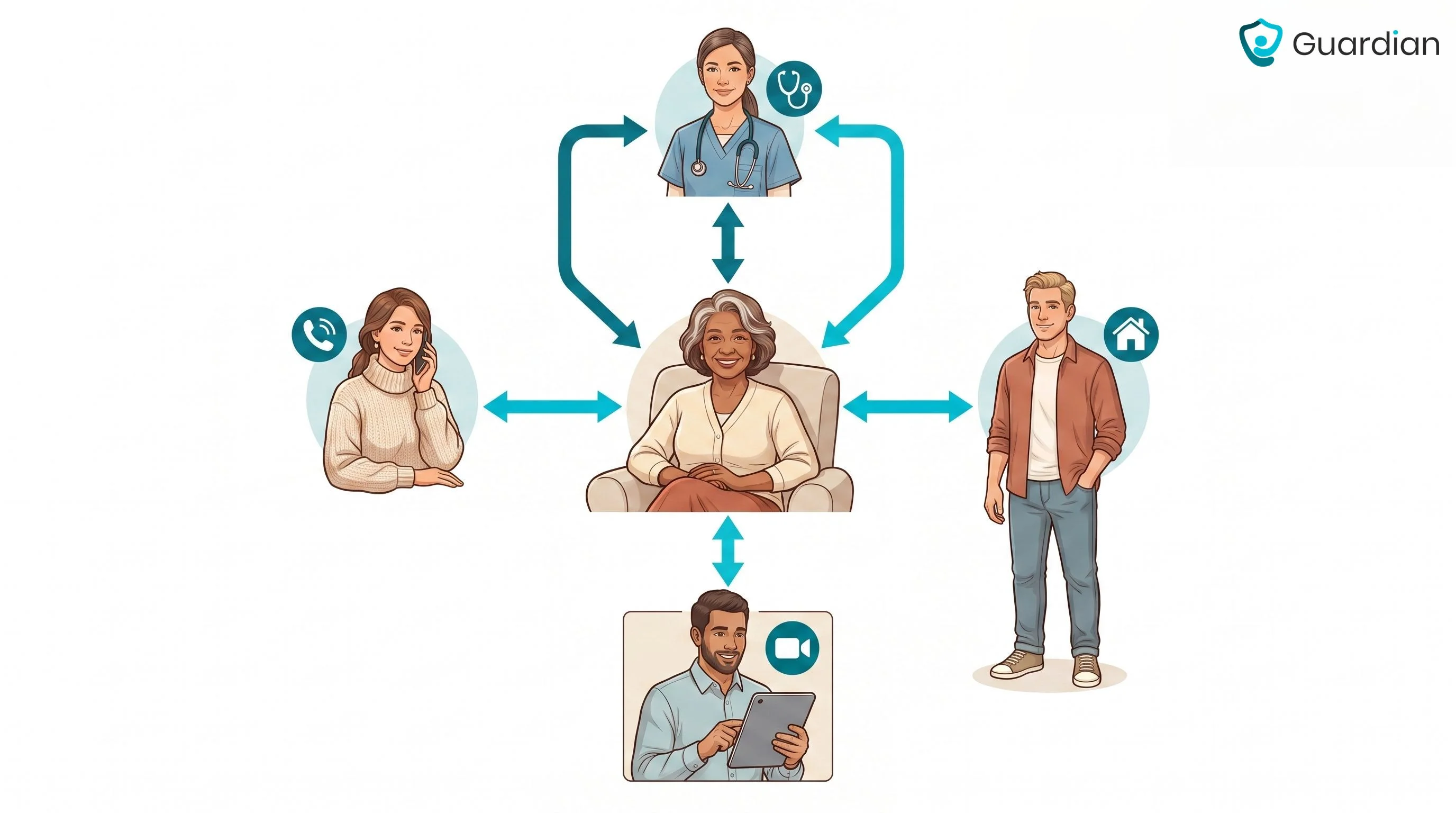
Remote care needs a named local person who can see what is happening. Choose one dependable nearby point person to complete agreed check-ins and update the support circle.
Keep the role limited. An informal helper should not become responsible for every task simply because no one else has been assigned the task.
Build reliability around the role:
Ask each person what they can cover regularly and what they cannot.
Assign one backup for routine visits and another for short-notice absences.
Before using paid help, verify identity and references. Check that experience, qualifications, registration, and regulatory status match the agreed personal or clinical tasks.
Include the GP practice or community pharmacist when medical or medication coordination is part of the plan.
Pick one update method and confirm that each team member can use it.
Reassign work after missed check-ins before gaps become routine.
3. Create a shared care plan
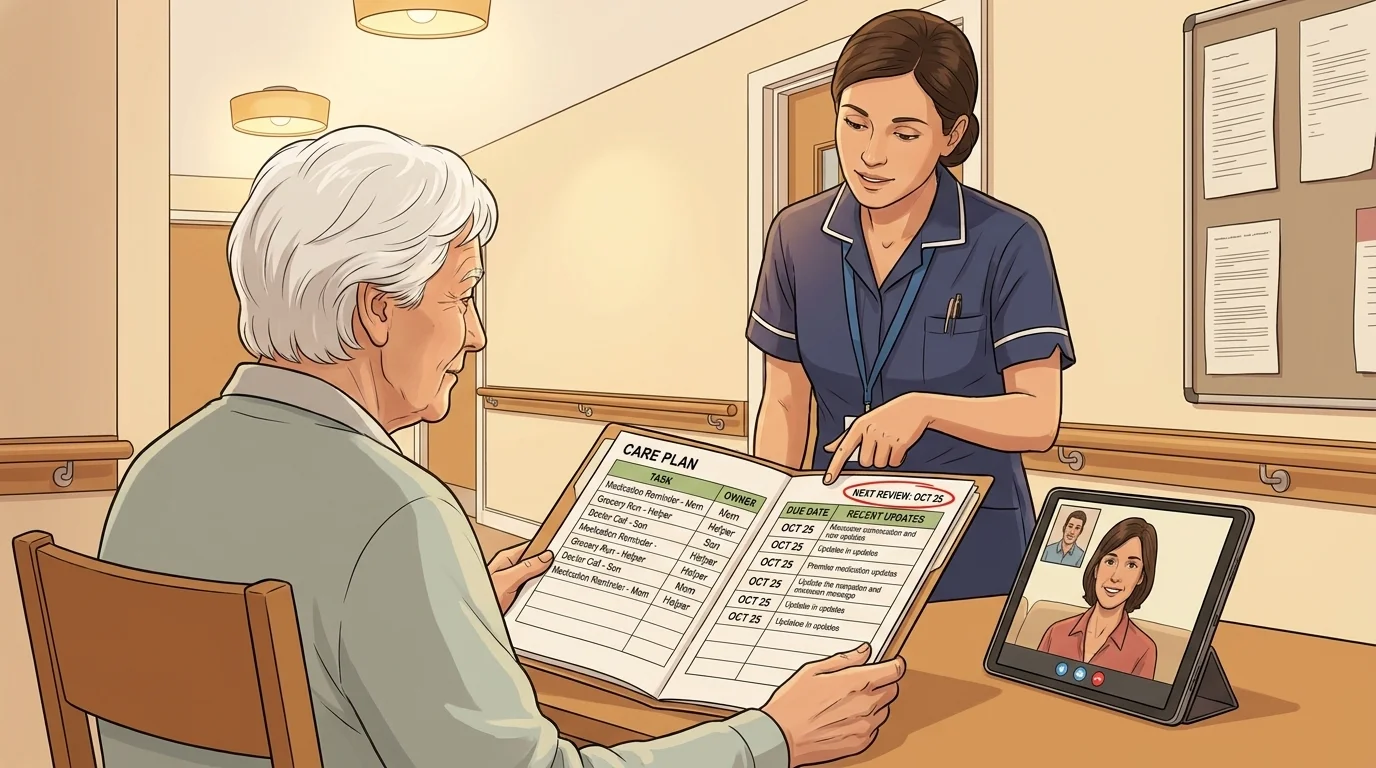
Treat the shared plan as a live handover between your parent, the lead coordinator, and agreed helpers. Keep it in one place, with one person responsible for updates and a named backup.
Update the plan after a change, not only on review day.
One owner per task: Give every action an owner and due date. “Someone will call” leaves a gap when the appointment is tomorrow.
One secure record: Store updates together instead of splitting them between paper notes and message threads. Limit access to people who need the relevant health, financial, or monitoring information.
Keep a change log: Date each missed visit, new concern, and instruction. Record who will follow up so old directions do not remain in circulation.
Set the next review: Choose a date before ending the current review. Bring it forward when needs, routines, or helper availability change.
Close completed actions first. Then assign unresolved gaps and confirm the support still follows your parent’s wishes.
Plan element | What to document |
|---|---|
Lead coordinator | Primary caregiver and backup contact |
People and roles | Family tasks, local helpers, clinicians, service providers |
Health information | Conditions, medications, appointments, care preferences |
Daily support | Meals, transport, home help, check-in schedule |
Emergency response | Who to call, when to escalate, hospital preferences |
Monitoring and review | Targeted alerts, routine changes to watch, next review date |
4. Put legal authority in place
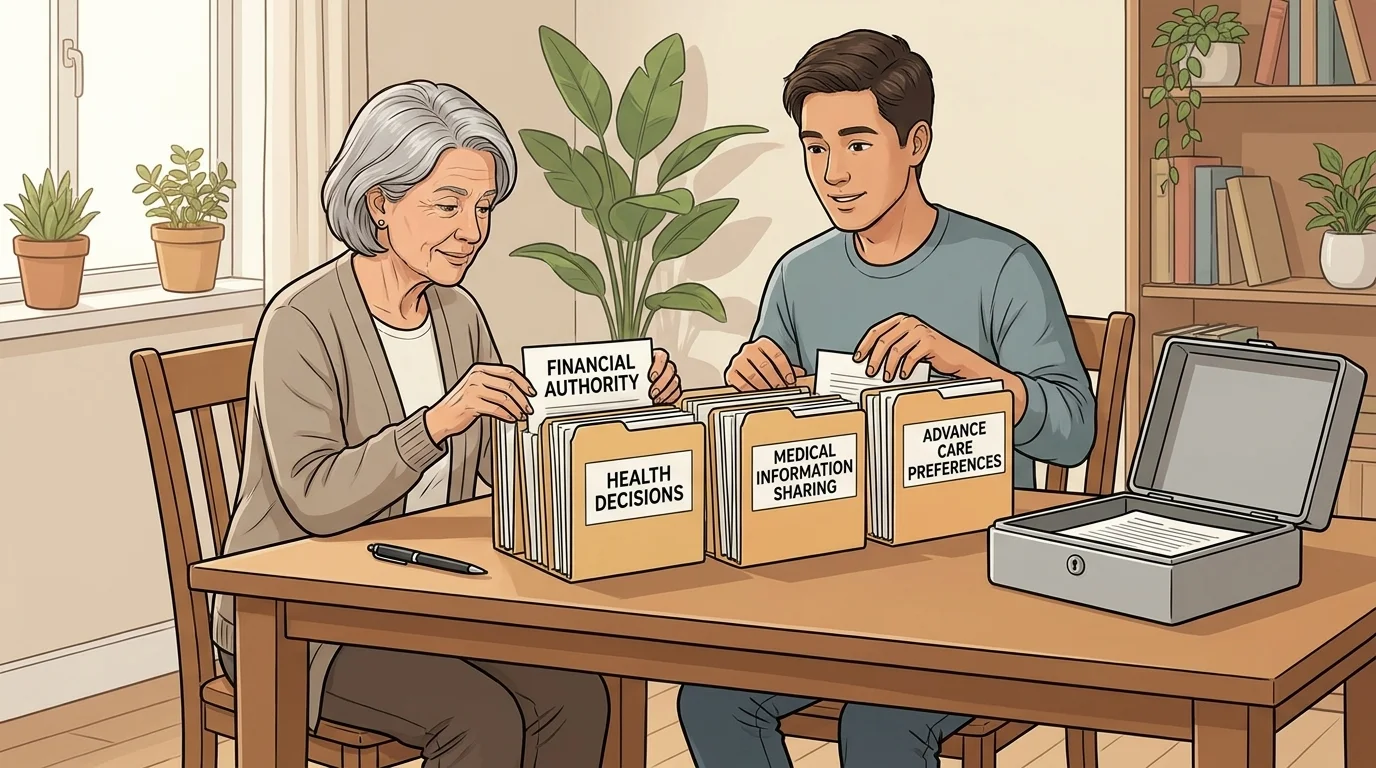
Legal authority determines who may act for your parent. Document names, scope, signing rules, and capacity requirements differ by jurisdiction.
Financial authority: A power of attorney or local equivalent may authorise someone to handle specified legal or financial matters.
Health decision authority: A separate document may name someone to make health decisions if your parent cannot do so.
Health information permission: Consent to receive medical information is separate from decision-making authority. Confirm what each clinician requires.
Advance care preferences: An advance directive, living will, or local equivalent records treatment wishes for future care.
A will and beneficiary records support estate administration after death. They do not usually grant authority during your parent’s lifetime.
Ask a qualified local lawyer to review the arrangements before a hospital admission or sudden decline forces a decision. Keep signed copies secure and accessible to each authorised person.
Phase 2: Coordinate everyday care
5. Coordinate medical care
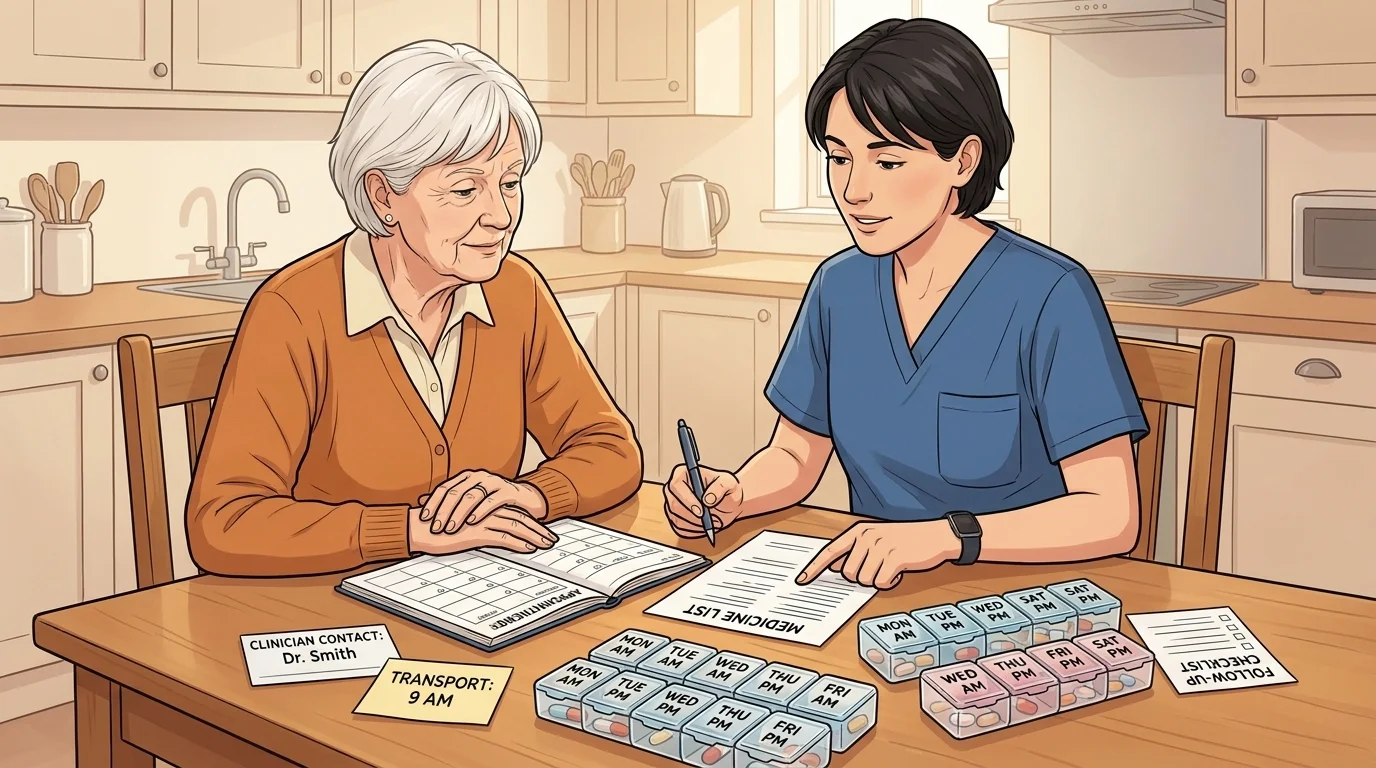
Coordinate medical care through one current health file and a repeatable follow-up routine. A clinician joining a call should be able to see the current medication list and the last appointment’s instructions.
Keep one health file: Store current conditions, medicines, care contacts, and valid permission to share information. Do not rely on an outdated prescription photo.
Prepare for appointments: Confirm transport and share the agenda with consent. Join remotely only when your parent agrees or you hold the required authority, then record instructions and the next date.
Reconcile medicines: Update the medicine list after discharge, a prescription change, or a dose change. Confirm unclear instructions with the prescriber or community pharmacist.
Use the right response: Arrange local professional support when a problem recurs. Use urgent clinical advice for time-sensitive concerns and emergency services when immediate danger or serious injury is possible.
Bring in local help when problems repeat.
Repeated medication confusion or missed appointments need a local response.
A geriatric care manager or house-call support can review what is breaking down and coordinate next steps.
6. Manage finances and benefits
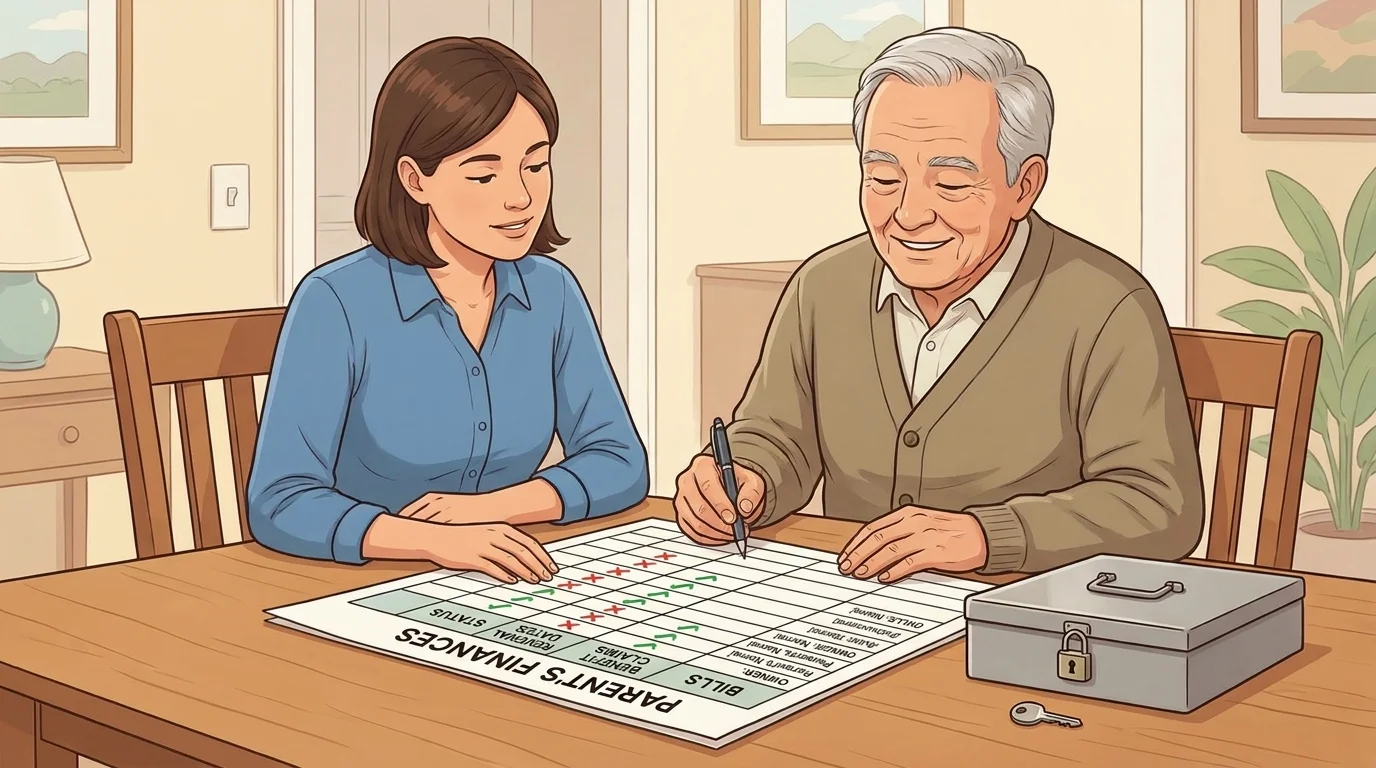
Manage finances and benefits with one secure record and a named bill-pay owner. Confirm that this person has the required legal authority, and keep a dated claims log showing what is pending or complete.
Start with existing records: Gather the accounts and documents already used for bills and insurance. Add each supporting document requested on an application.
Name the bill-pay owner: Give one person responsibility for the payment calendar and use autopay for predictable bills where appropriate. A late notice should have one named person to handle it.
Protect access: Do not share account passwords casually. Limit access, review unusual payments or new payees, and record concerns that may indicate a scam or financial exploitation.
Keep each claim visible: Log the claim reference beside its submission date. Update the same entry whenever the insurer changes the status or requests information.
For benefit applications: Use official forms and follow the evidence checklist. Save the completed form with proof of submission.
Follow through: Record every request for more information and the date of reply. Add renewal dates to the shared calendar, then save written confirmation of the outcome where available.
Keep the next action visible.
A single record should show the latest status and who acts next. That record matters when a notice arrives while the usual coordinator is away.
7. Arrange daily living support
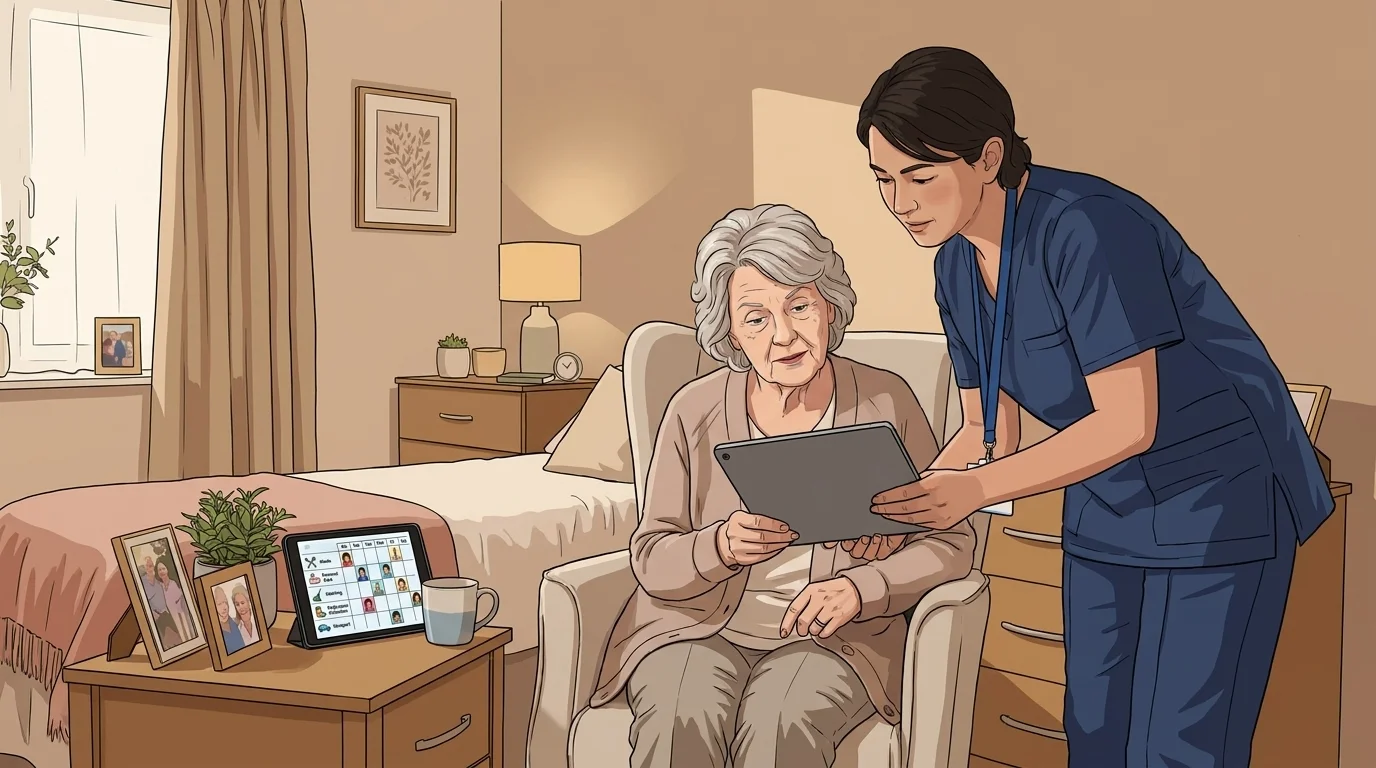
A fridge full of spoiled food or a missed lift to a clinic reveals more than a catalogue of services. Match each recurring gap to local help before it becomes an emergency.
Meals: Arrange grocery delivery, prepared meals, or cooking support when food is skipped or spoils.
Companionship: Arrange regular local contact when isolation or reduced social activity is affecting the routine.
Personal care: Add help with washing, dressing, toileting, or transfers when these tasks become unsafe.
Household tasks: Use cleaning, laundry, or maintenance services where the home is becoming difficult to manage.
Errands and medication: Arrange shopping, prescription collection, or medication support through an appropriate provider.
Transport: Set up reliable travel for appointments and essential errands before missed journeys affect care.
Confirm what care was delivered
Ask the home care provider what counts as a completed visit, how cancellations are covered, and how exceptions are reported. Confirm three separate facts:
Arrival: A reliable record shows whether the worker attended.
Duration: Start and finish records show whether enough time was provided.
Completion: A short task record confirms what was done and flags anything missed.
When needs change, change the support
No-shows or short visits: Ask the home care provider to explain the gap, arrange the agreed backup, and record corrective action.
Repeated unmet needs: Change the service level or provider. Informal reminders do not fix a recurring care gap.
New physical or cognitive difficulty: Review whether tasks, supervision, or professional input must change.
Changes in independence: Adjust support with your parent, preserving safe routines and everyday choices wherever possible.
8. Maintain contact and plan visits

Calls and visits do different jobs. A regular call preserves the relationship; a planned visit or local check-in verifies the details that distance hides.
Calls should feel like calls
Ask about the best part of the day and anything worrying them. A call cannot show an uncollected prescription or a cold kitchen, so follow concerns with a practical check.
Set a missed-contact protocol
Agree how long to wait, who calls next, when someone local checks, and what triggers emergency help.
Keep contact tools usable with charged devices, simple contacts, large text, or hearing support where needed.
Visits show the routine
Plan practical tasks alongside unhurried time together. During each visit:
Observe daily life: Notice mobility, mood, food, hygiene, and the condition of the home.
Review recent changes: Check new symptoms, appointments, letters, or service problems.
Confirm support: Compare planned help with what was actually delivered.
Resolve one priority: Complete the most important practical task before leaving.
Protect the relationship: Make time for an activity your parent enjoys.
Between visits, name a local contact
With your parent's consent, assign one named nearby person who can check in, observe conditions, and respond when contact is missed. Record their contact details and backup.
Agree the check-in frequency from current risk, not convenience. Increase it after a fall, illness, service failure, or cognitive change; reduce it only when the situation is stable and everyone agrees.
9. Prepare emergency and backup plans
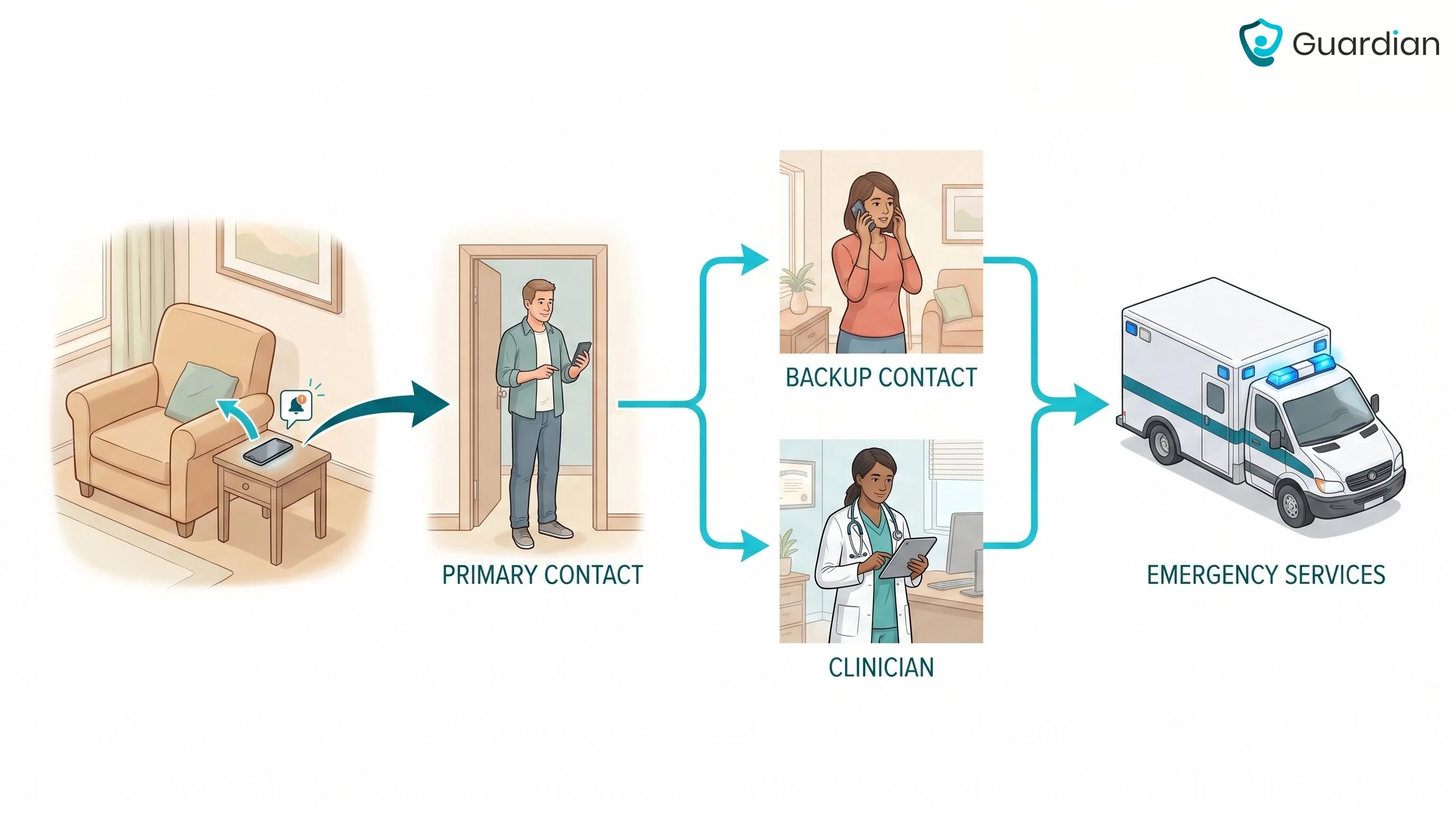
A neighbour may be at the door while you are hours away. Write a plan local responders can use immediately, and tell them where its secure copy is kept.
Use the table below as the working plan. Fill every field, confirm that each responder accepts the role, and update it whenever health, medication, access, or care arrangements change.
Plan element | What to specify |
|---|---|
Local responders | Primary contact, backup contact, overnight contact |
Emergency file | Phone numbers, medication list, diagnoses, insurance, legal documents |
Escalation rules | When to call family, 111, 999, clinician, or pharmacy |
Coverage gaps | What happens during falls, wandering, illness, or caregiver absence |
Plan for situations where your parent cannot call
A manual call button helps only when it is within reach and the person can recognise the emergency, press it, and wait for a response. It may fail during unconsciousness, immobility, confusion, or an unwitnessed fall.
Use passive monitoring as a backup so an unusual event can be noticed without requiring deliberate action. Record who receives that notification and who attends if the primary responder is unavailable.
Emergency numbers and falls guidance vary by location. Record the correct local contacts, keep the emergency file secure, and follow current clinical guidance for your parent’s setting.
Rehearse the contact chain so each person knows when to act, when to escalate, and how to enter the home safely.
Phase 3: Add monitoring and a response route
10. Map risks and choose monitoring
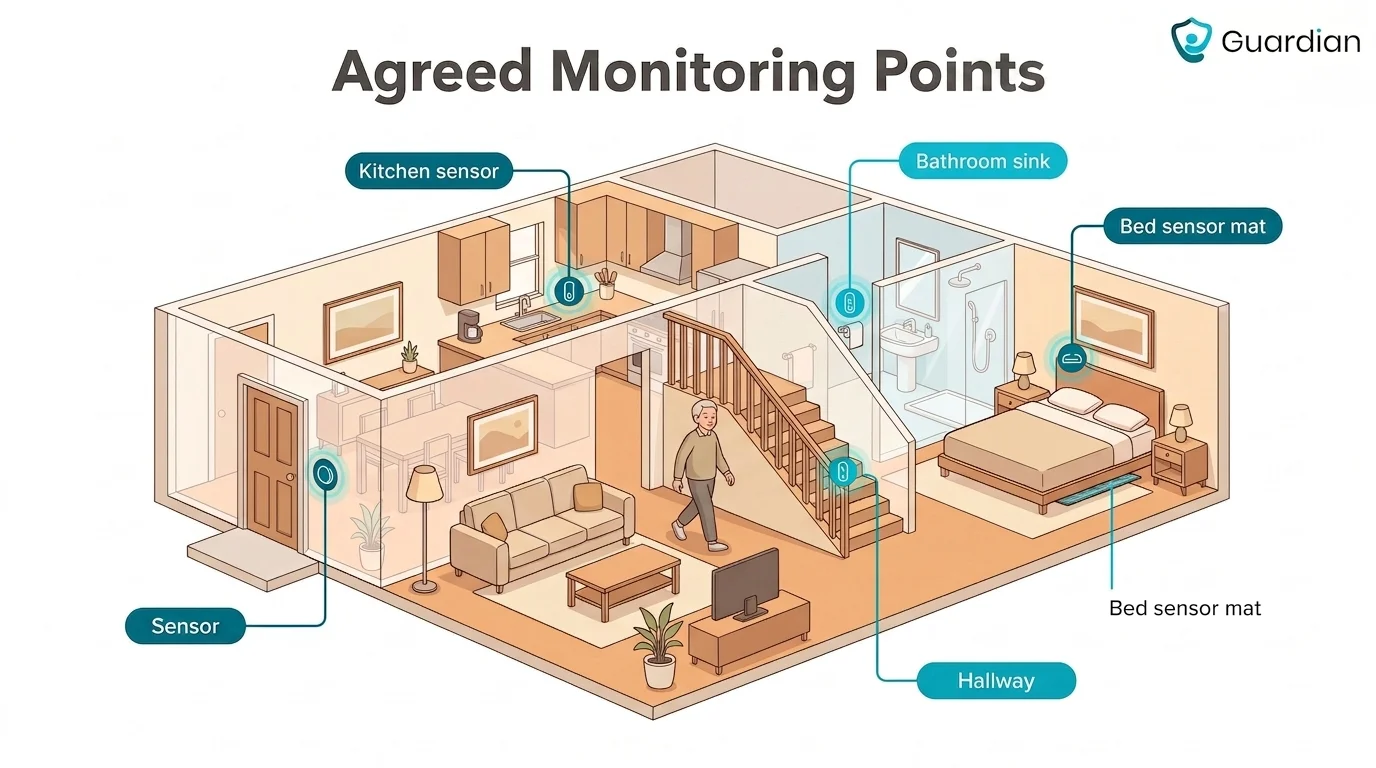
Start with consent and a short risk map, not a shopping list. Monitor only where a signal leads to a defined action by a named person.
For a parent living at home: Map concerns around doors, bed exits, bathroom use, stairs, cooking, meals, and missed routines. Confirm who can check in and enter the home.
For a parent receiving managed care: Ask the provider to show how each sensor or wearable maps to a person and location, who receives the alert, and how the response is recorded.
Check four things before relying on monitoring:
Defined risk: State one event that needs a response.
Mapped place or routine: Connect each signal to the exact location or routine it is meant to cover.
Live test: Trigger each installed device where it will be used and confirm one alert is created.
Response route: Confirm the agreed caregiver receives the alert and knows what action to take.
11. Connect responders and configure alerts
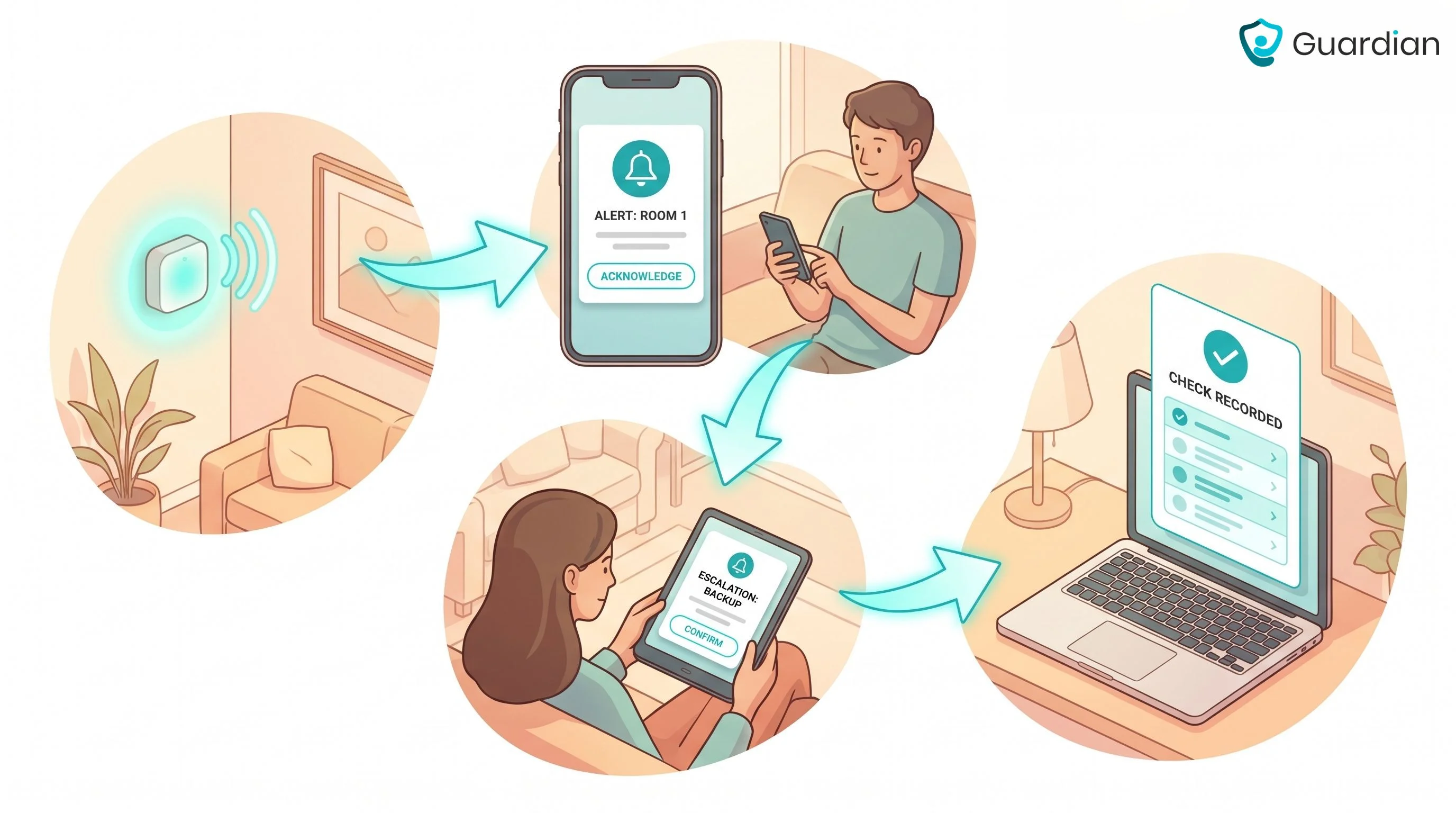
An alert without a local owner tells remote family that something may be wrong, then leaves them calling around. Name a primary responder and local backup before the alert goes live.
Test the route before relying on it:
Set the response target: Match acknowledgement and in-person check expectations to the event, staffing, distance, and agreed care plan.
Run realistic tests: Include routine handovers, absences, and overnight coverage before relying on the route.
Record both intervals: Log alert-to-acknowledgement and acknowledgement-to-local-check times.
Setup check | Decision | Proof before go-live |
|---|---|---|
Alert owner | Name primary and local backup | Both receive assigned test alerts |
Delivery | Choose a reliably monitored channel | Alert appears on assigned device |
Acknowledgement | Set expectation appropriate to risk | Primary acknowledges; backup practices takeover |
Training | Show context, ownership, next action | Each user completes practice alert |
Device status | Match dashboard to installed devices | Every connected device shows active |
What to ask a care provider to prove
Ask the provider to demonstrate:
Completed visit records, including arrival, duration, and exceptions
Alert acknowledgement and in-person check times
The resident and exact location attached to each alert
Backup coverage when the first responder or caregiver is unavailable
Who can access monitoring data, how long it is kept, and when access is removed
Guardian gives care homes and home care providers these controls in one camera-free, wireless platform. It records visits and response times, routes location-aware alerts to staff devices, and supports passive sensors when a wearable is unsuitable.
12. Monitor routines between visits
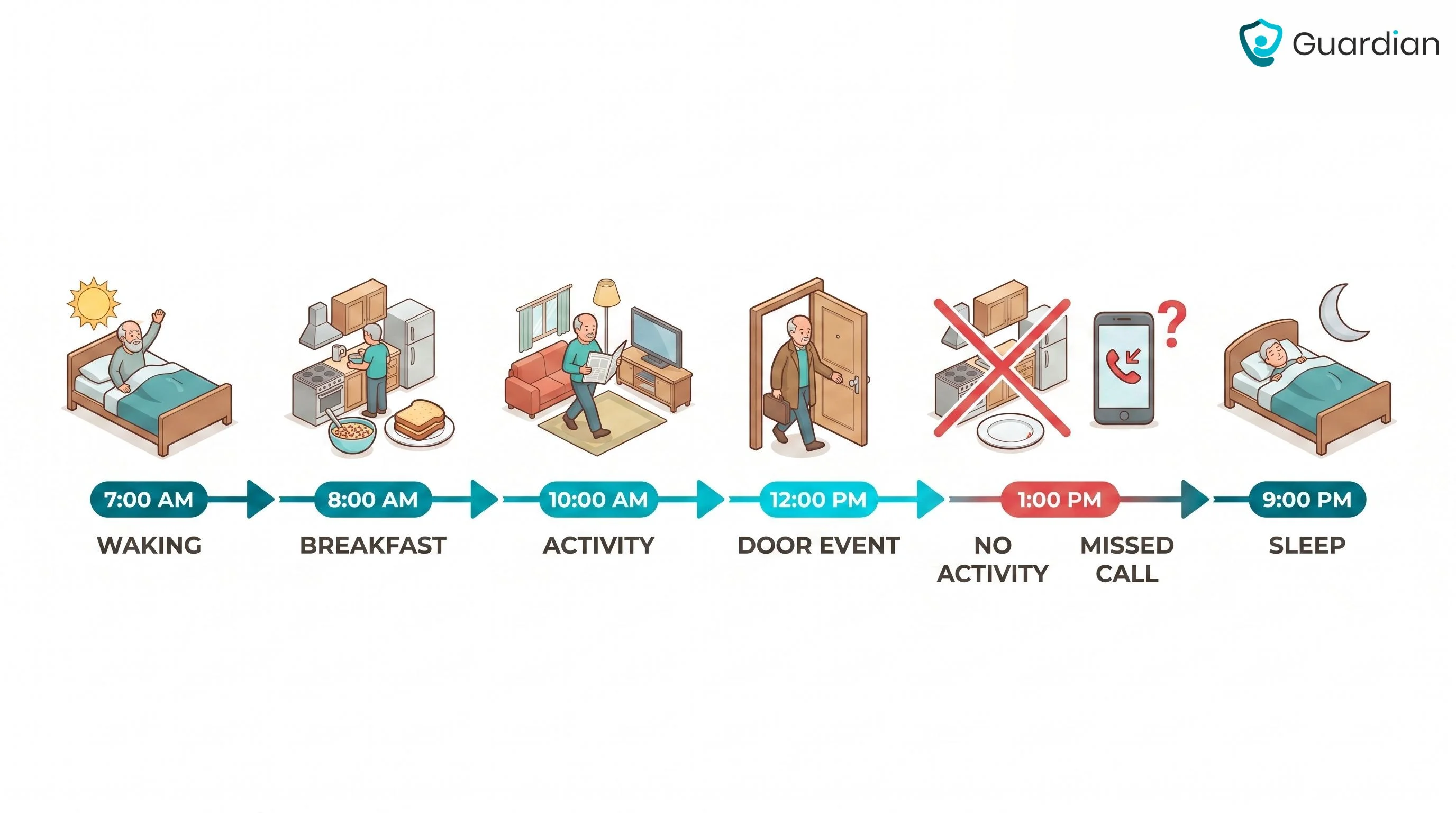
Routine monitoring should answer one narrow question: has something changed enough to justify human contact? Act on sudden or serious changes immediately, and review slower changes against the parent’s usual pattern.
Use only the signals your parent accepts. Limit access to people involved in care, set a retention period, remove access when roles change, and revisit consent whenever the monitoring plan changes.
Use context before escalating.
A late kitchen visit can be ordinary. No activity alongside an unanswered call can justify asking someone local to check.
Consented signal | Compare with | When to act |
|---|---|---|
Motion | Usual active times and rooms | Call after unexplained inactivity |
Door | Normal exits and expected visitors | Call; local check if unsafe |
Fridge or stove | Usual meal and appliance pattern | Call about meals or safety |
Bed | Usual sleep and return pattern | Local check after concerning absence |
Optional wearable | Agreed use and expected location | Follow the agreed safety plan |
Several signals | Changes across the normal routine | Seek clinical assessment if concerning |
13. Respond and reassess care
[Image: Five-part editorial alert-response loop showing: assign one responder, confirm the older parent’s status and exact location, send the local responder, record acknowledgement and check times, then update the shared care plan. Use five clearly connected scenes with realistic people, simple symbols, warm muted colours, clean outlines, minimal readable text, landscape format, and no logos.]
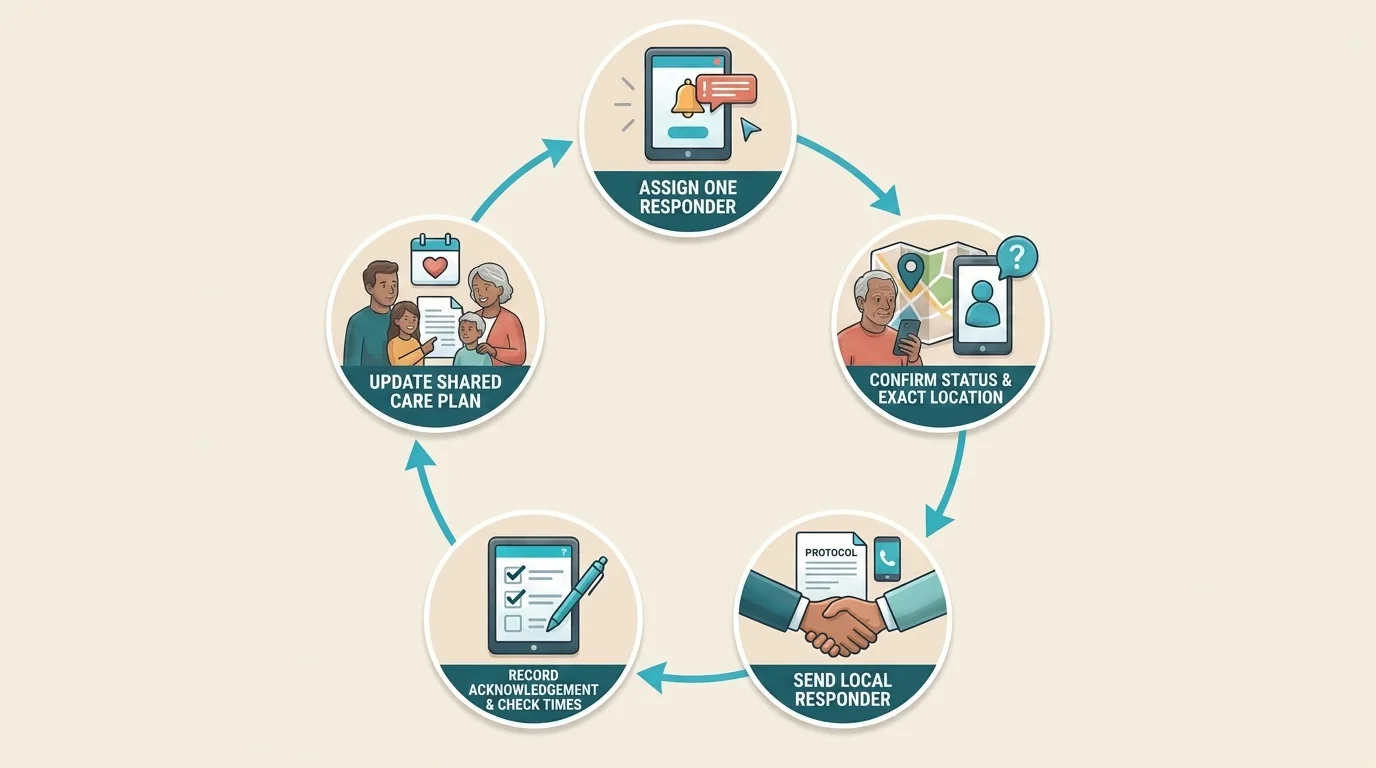
Treat every alert as a response loop. Close it only after a responder is named, the person is checked, the action is recorded, and any needed plan change is assigned.
Confirm a single responder before anyone else assumes the alert is covered.
Check the person's status and exact location. Confirm the event time and whether another responder is already involved.
Send the named local responder. Contact emergency services whenever immediate danger or serious injury is possible; do not wait for remote confirmation.
Record acknowledgement and local-check times during the early use period. Note what the responder found and whether the route worked.
Add serious events and recurring patterns to the shared care record for review.
Review the plan after a serious event, a failed response, or a recurring pattern. Discuss repeated overnight alerts together rather than treating each as an isolated note.
Phase 4: Plan for change
14. Choose the right care setting
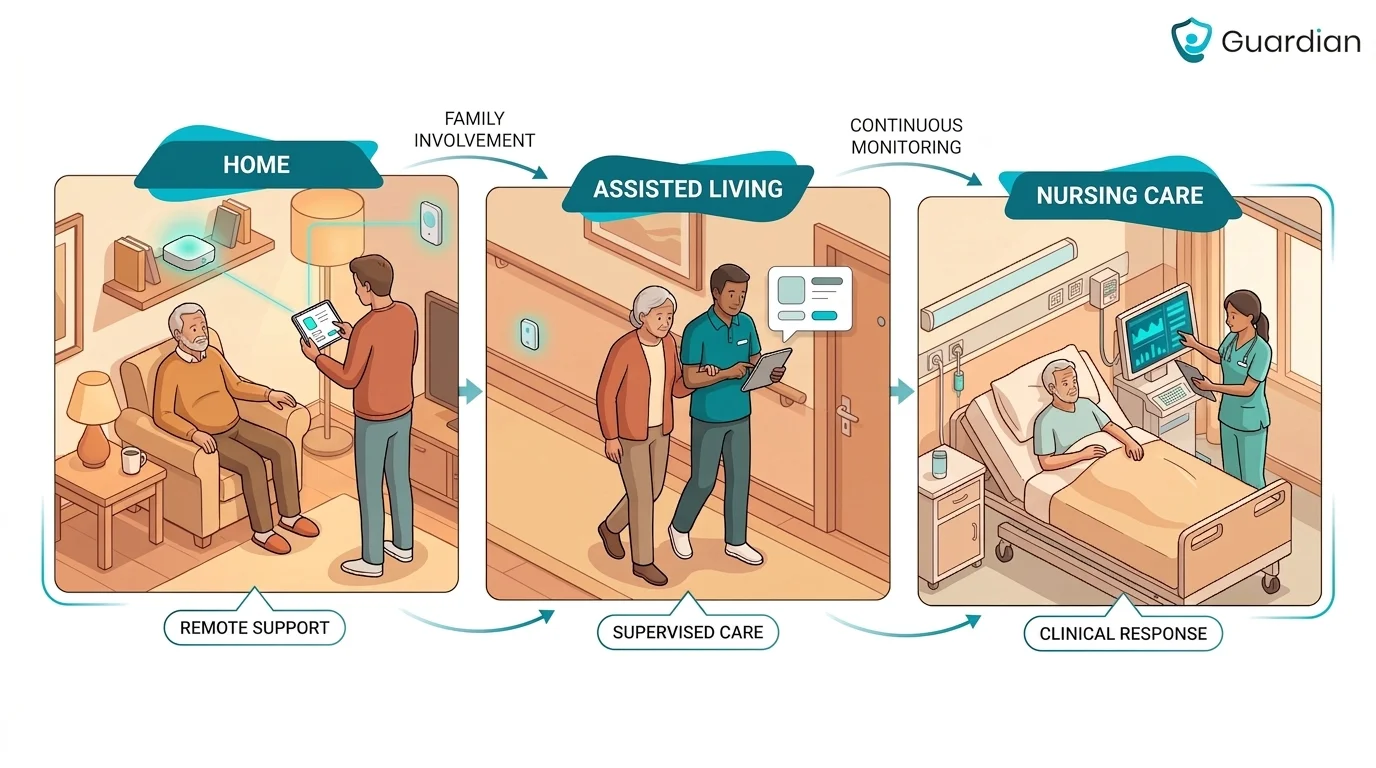
Remote support stops being enough when safety relies on physical presence and coverage keeps failing. A new alert cannot protect a parent alone at 2 a.m.
Repeated gaps warrant a care-setting conversation, even when a parent wants to stay home.
Falls or near misses continue despite current support.
Unsafe exits or wandering happen when no local person can arrive.
Medication records show errors that the current support does not catch.
Overnight help cannot arrive when it is needed.
A missed carer visit leaves no confirmed backup.
Confusion makes daily routines or safety decisions less reliable.
Choose the least restrictive setting that reliably covers the identified risk. Include your parent’s preferences, decision-making capacity, clinical assessment, and the local response available on an ordinary night.
A polished tour is not proof of overnight coverage. Compare each setting by the supervision, clinical support, and local response available on an ordinary night.
Call agencies and facilities in the area, then confirm they cover the required level of care.
Tour at an ordinary operating time. Ask how overnight coverage works and what happens after a missed visit or medication error.
Name one transition lead for the handover. That person coordinates records and medication information.
Arrange frequent contact during the early transition period with your parent, the care team, and the transition lead.
Review any unmanaged gap immediately. Adjust the plan before a transition problem becomes the new routine.
Setting | Typical fit | What to verify |
|---|---|---|
Expanded in-home support | Parent can remain at home if physical presence is now reliable | Coverage for nights, medication help, fall response, backup for no-shows |
Assisted living or senior living community | Parent needs daily support and family visibility but not constant nursing care | Staff availability, communication with family, emergency response process |
Nursing home or higher-acuity setting | Parent has ongoing safety or medical needs that exceed home support | Clinical oversight, falls pathway, medication management, supervision level |
15. Protect your caregiving capacity
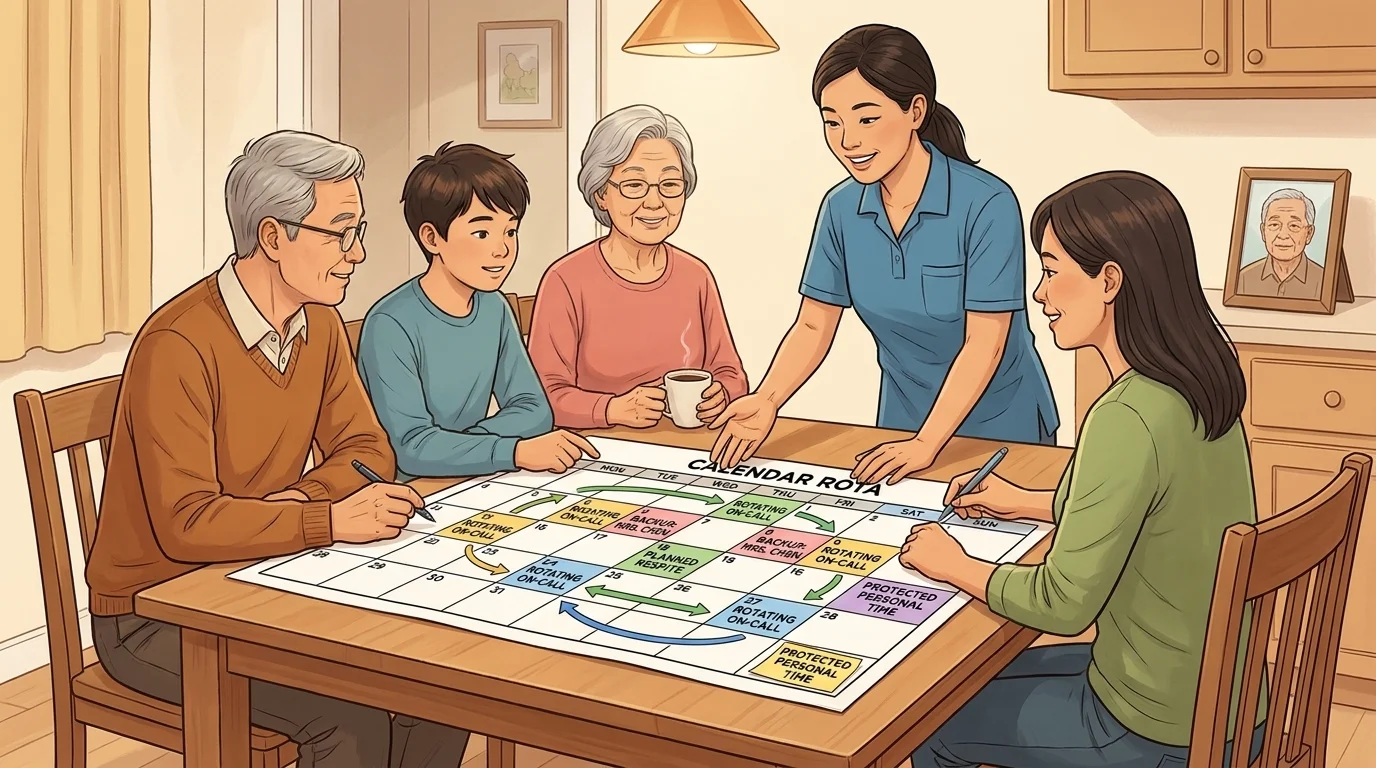
Do not build a care plan around one remote family member being constantly available. Monitoring can flag a change, but it cannot replace dependable local help.
Interrupted sleep, missed work, delayed decisions, and no available backup show that the plan depends too heavily on one person. Set boundaries and backups while routines are stable:
On-call hours: Agree which alerts require an overnight call and where non-urgent updates go.
A rotating first call: Use a weekly rota to share first-response duty across relatives.
Respite in the calendar: Arrange regular relief before missed sleep turns routine decisions into rushed ones.
A nearby responder: Name someone who can visit when an alert or missed call needs an in-person check.
Time that remains yours: Keep regular time for your own commitments instead of allowing coordination to fill your schedule.
Sustainable coordination depends on clear boundaries and dependable local coverage, not constant remote availability.
Keep the plan local, current, and tested
Long-distance care works when someone nearby can act, the care record stays current, and everyone follows the same response plan after a missed call, visit, or alert. Review the plan whenever needs change or local coverage becomes unreliable.
For care operators: Guardian gives care homes and home care teams camera-free monitoring, automatic records, and location-aware alerts on devices staff already use. Start with one ward or home care team, deploy in about a week, and use a 6–8 week pilot to measure response times, visit verification, and operational impact with your own data.

Name a local responder and involve the relevant clinician. Agree who will act after wandering, sudden confusion, or a missed routine.
With consent, camera-free monitoring can flag changes between visits. Treat the signal as a reason to check, not as a diagnosis.
Base visits on current health, mobility, cognition, local support, recent incidents, and your parent’s preferences. Bring a visit forward when local observations and remote updates no longer match.
Do not wait for planned travel after a serious fall, wandering episode, medication problem, or support breakdown. Arrange local or emergency help immediately when danger is present.
Put authority in writing before a crisis. Your parent may need separate documents for financial decisions, health decisions, advance care preferences, and permission to share medical information.
Names and legal effects vary by jurisdiction, so ask a qualified local lawyer to confirm what is valid. Keep signed copies secure and accessible to the people named.
A will and estate records serve a separate purpose. They do not usually grant authority during your parent’s lifetime.
Ask for records of completed visits, missed or shortened calls, response times, backup coverage, and actions taken after an alert. Confirm who can see the records and how your parent’s privacy is protected.
Do not turn refusal into a contest. A parent who understands the risk may make a choice the family dislikes, so start with their goal and offer one limited support that protects it.
If your parent may not understand or weigh the risk, seek a qualified capacity assessment and local professional advice. Arrange urgent in-person or emergency help when there is immediate danger.

Author
Aleks Timm
Aleks Timm leads Guardian and builds privacy-first operations technology for care homes and home care providers. Teams get location-aware alerts they can act on, clearer situational awareness, and measured insight into how care work actually runs.
Read MoreRecommended reads
Keep reading
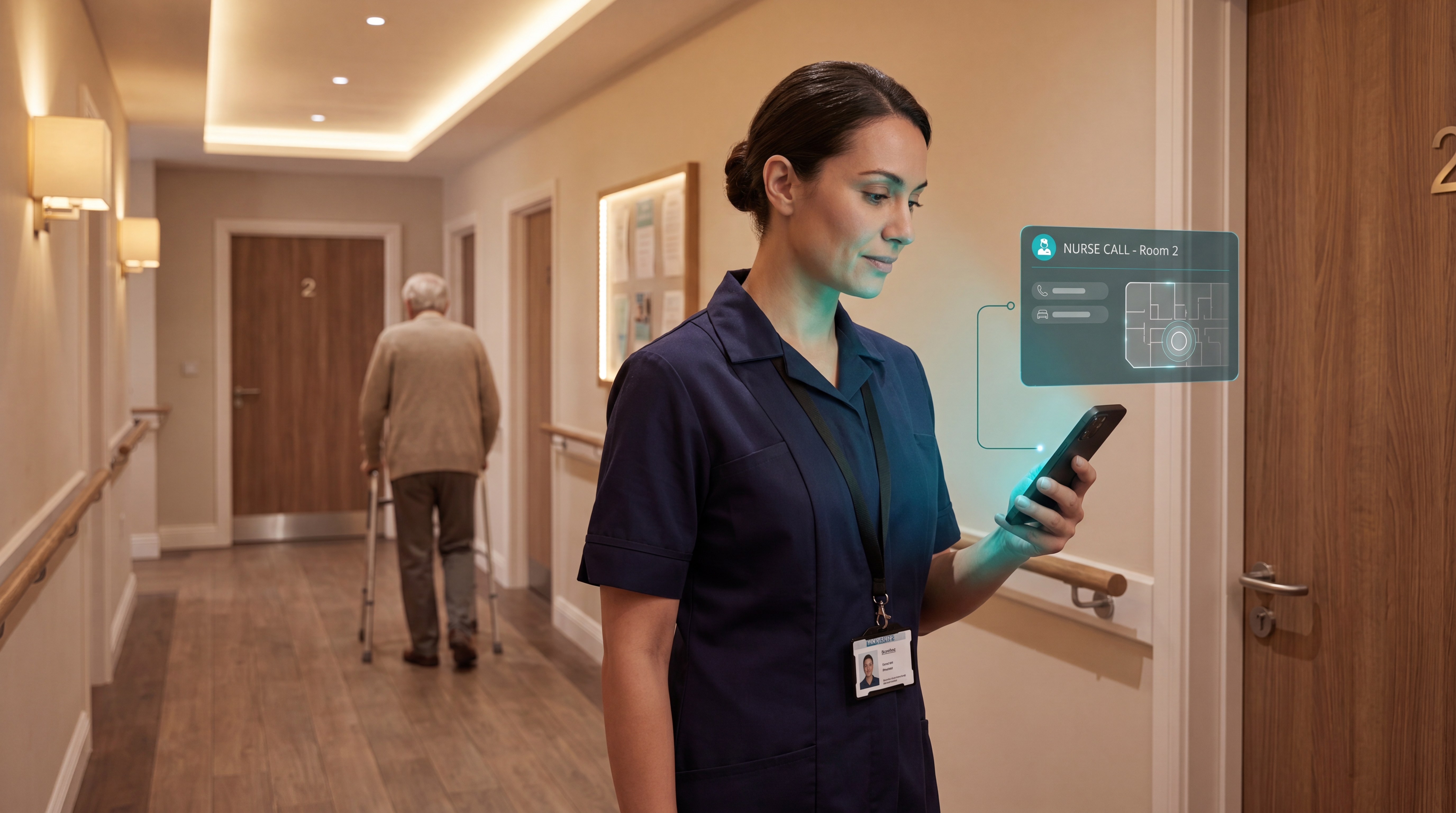
Smart Nurse Call Systems for Care Homes and Home Care Providers
Smart nurse call systems for care homes and home care providers: compare features, improve response times, and choose the right...
Read more
WiFi nurse call system guide for care homes
WiFi nurse call systems explained: alerts, clean records, and no wiring—compare options and choose the right setup for your care...
Read more
Remote patient monitoring: a complete guide
Remote patient monitoring: the complete guide to sensors, benefits, and buying tips for safer care homes and better resident...
Read more